

- Published:
- Tuesday 13 October 2026 at 3:58 pm
‘[It is] really impactful for me to know I did something not just for me but for others.’ – former Victoria Legal Aid client Em
Our new report and guide demonstrates how lawyers can use sexual harassment cases to achieve changes that protect others, as well as remedies for clients.
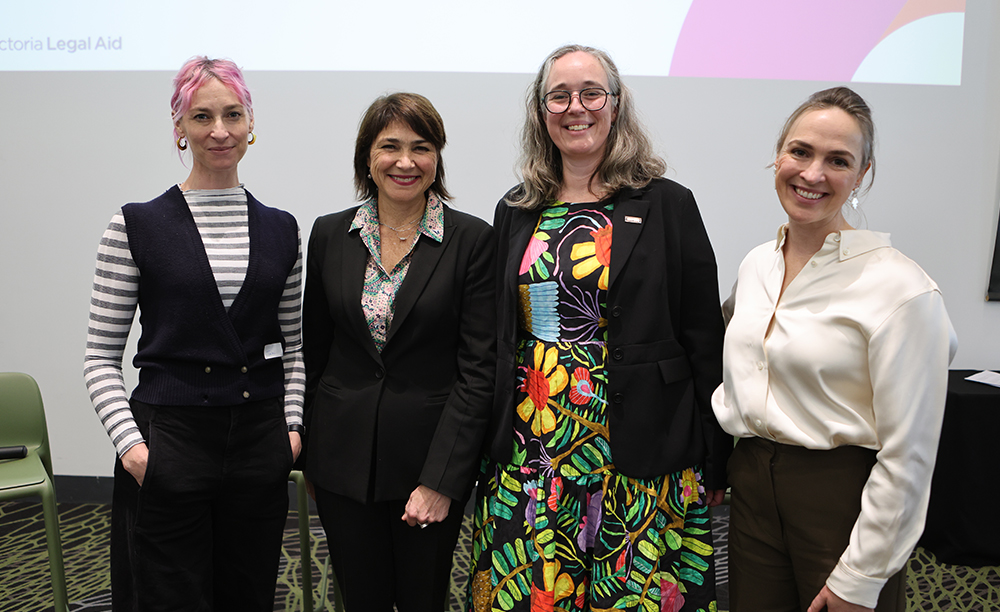
We were honoured to be joined by Sex Discrimination Commissioner Anna Cody, who helped launch Achieving systemic outcomes in sexual harassment cases – report and legal advocacy guide on Tuesday.
The report highlights how our lawyers have achieved systemic outcomes in recent practice and provides a step-by-step guide for other legal professionals to do the same.
Systemic outcomes are steps an organisation takes to prevent sexual harassment from happening again, such as audits, training, stronger policies and reporting processes, and limits on non-disclosure agreements.
‘These outcomes can help prevent future harm, improve workplace safety, and support lasting cultural and structural change,’ said Associate Director Catherine Hemingway, from our Equality Law Program.
‘Our report looks at the legal avenues individual victim-survivors can take to propel broader change, and importantly, as lawyers and advocates, how we can assist with that.’
All employers have a positive duty to eliminate workplace sexual harassment. This positive duty is a legal obligation introduced into the Sex Discrimination Act 1984 (Cth) in 2022.
Breaches of the positive duty can only be enforced by the Australian Human Rights Commission, but our report shows how through individual claims, victim-survivors can also drive organisational change.
Em’s story
Em was a teenager when she was sexually harassed by a duty manager at her casual job. When she reported it to managers, she was subjected to serious victimisation including retaliation.
We helped Em with her legal complaint, resulting in significant changes to the employer’s training and policies. It included having the organisation’s staff, including Board members, completing training on preventing and addressing sexual harassment.
‘To me, taking action wasn’t just about change for myself,’ Em said.
‘Knowing I have changed a company for the better is huge. That was probably the best thing out of all of it.’
Systemic outcomes matter
Our clients often tell us they want to make sure what happened to them never happens to anyone else.
In 2025–26, we provided over 5500 information services to people about discrimination, sexual harassment and employment matters. The Equality Law Program also provided more than 1000 legal advice services, 98 duty lawyer services and minor assistance files, and opened 75 litigation files, recovering over $1.1 million in compensation.
Critically, we also obtained a range of non-financial remedies such as apologies, staff training and changes to discriminatory practices.
These non-financial outcomes have a positive effect on our clients’ lives and the potential to create significant systemic change. It is the focus of this report.
About the report and guide
Drawing on our practice and the guidance of our Sexual harassment lived experience reference group, the report and guide:
- explains the legal basis for seeking systemic outcomes under federal law
- provides a step-by-step guide to advising clients, negotiating outcomes and going to court, with sample settlement terms and orders
- recommends legal reforms to shift the burden of enforcement from victim-survivors to those with the power to prevent harm.
It was launched on 13 October at ELP’s Continuing Professional Development forum – Litigating for equality: Discrimination and sexual harassment claims as tools for change.
More information
Download the report and legal advocacy guide on LawHub
Access the Walk beside us report for guidance on working with victim-survivors
Got a question? Get in touch with our Equality Law Program at equalitylaw@vla.vic.gov.au
Read the Australian Human Rights Commission’s 2025 Speaking from experience report
Updated