

- Published:
- Tuesday 26 May 2026 at 2:00 pm
We are launching a two-year pilot to fund new family law roles in areas of high need in regional Victoria.
The pilot will fund six family lawyer roles at three community legal centres (CLCs) covering the Wimmera, the Goulburn Valley and the Ovens Murray regions.
We will be partnering with:
- Allied Justice (Wimmera/ Wotjobaluk, Jaadwa, Jadawadjali, Wergaia and Jupagulk Country)
- ARC Justice (Goulburn Valley/Yorta Yorta and Taungurung Country)
- Hume Riverina Community Legal Service (Ovens Murray/Yorta Yorta, Taungurung and Gunaikurnai Country).
Each CLC is located in, and services, an area of high unmet legal need, where clients struggle to find family lawyers.
The new roles will provide legal representation for clients with parenting, property, child support or spousal maintenance issues.
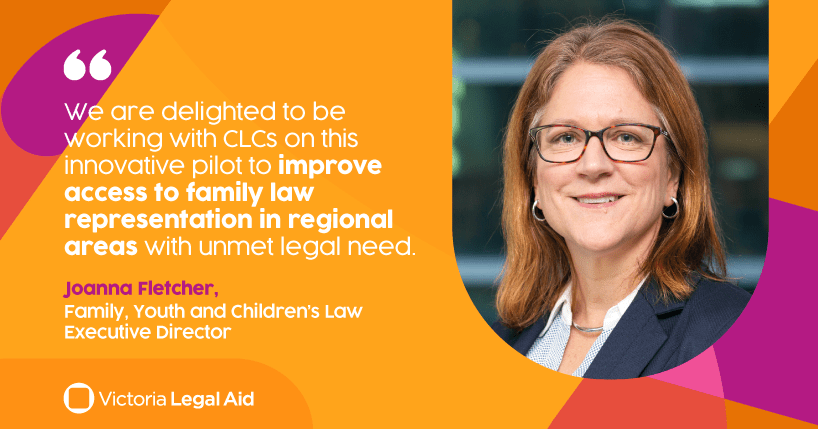
'We are delighted to be working with CLCs on this innovative pilot to improve access to family law representation in regional areas with unmet legal need,’ said Executive Director Joanna Fletcher, from our Family, Youth and Children’s Law team.
‘It forms part of our ongoing work to improve the balance of the mixed model and challenges with supply so we can be sure clients get the family law services they need, wherever they live.’
The three participating CLCs run established family law practices, allowing the pilot to begin quickly and helping us to track its full impact over the two-year period.
The pilot will test the efficacy of funding CLCs to do more family law work.
If effective, we hope to expand the pilot to other areas across the state with high legal need.
How the mixed model supports clients
People get free legal help, or legal aid, in different ways.
They might get a private lawyer, a CLC lawyer, or one who works at Victoria Legal Aid.
This is called the mixed model.
‘Despite everyone’s best efforts, the mixed model of service delivery is currently not meeting demand for family law assistance,’ said Joanna.
‘We are seeing growing gaps in access to practitioners, especially in regional areas where people can’t easily travel to get help elsewhere. At the same time, demand and case complexity are increasing.’
Private practitioners are a critical part of the mixed model.
Across child protection, parenting and property matters, family violence, and those involving independent children’s lawyers, private practitioners deliver between 80 to 90 per cent of all legal representation.
But in the last five years, we have seen the number of family law grants to private practitioners decrease by nearly a third.
‘It is our responsibility as a coordinator of funding to ensure services remain effective, available and accessible for clients,’ Joanna said.
Strengthening the mixed model
People experiencing family law issues deserve access to timely and effective support.
That is why we will continue to explore new ways to improve the sustainability of the mixed model.
Last year, we introduced new fees and increased fees for family law grants. On average, private practitioners are now able to claim an additional 10 per cent on payments compared to before the changes.
Four new changes to child support guidelines and fees also came into effect this March.
We also recently rolled out new in-house roles strategically placed in areas with unmet need for family law assistance.
More information
For questions about the pilot, please reach out to Family, Youth and Children’s Law Project Coordinator Aimee Barns.
Learn more about the mixed model.
Updated